
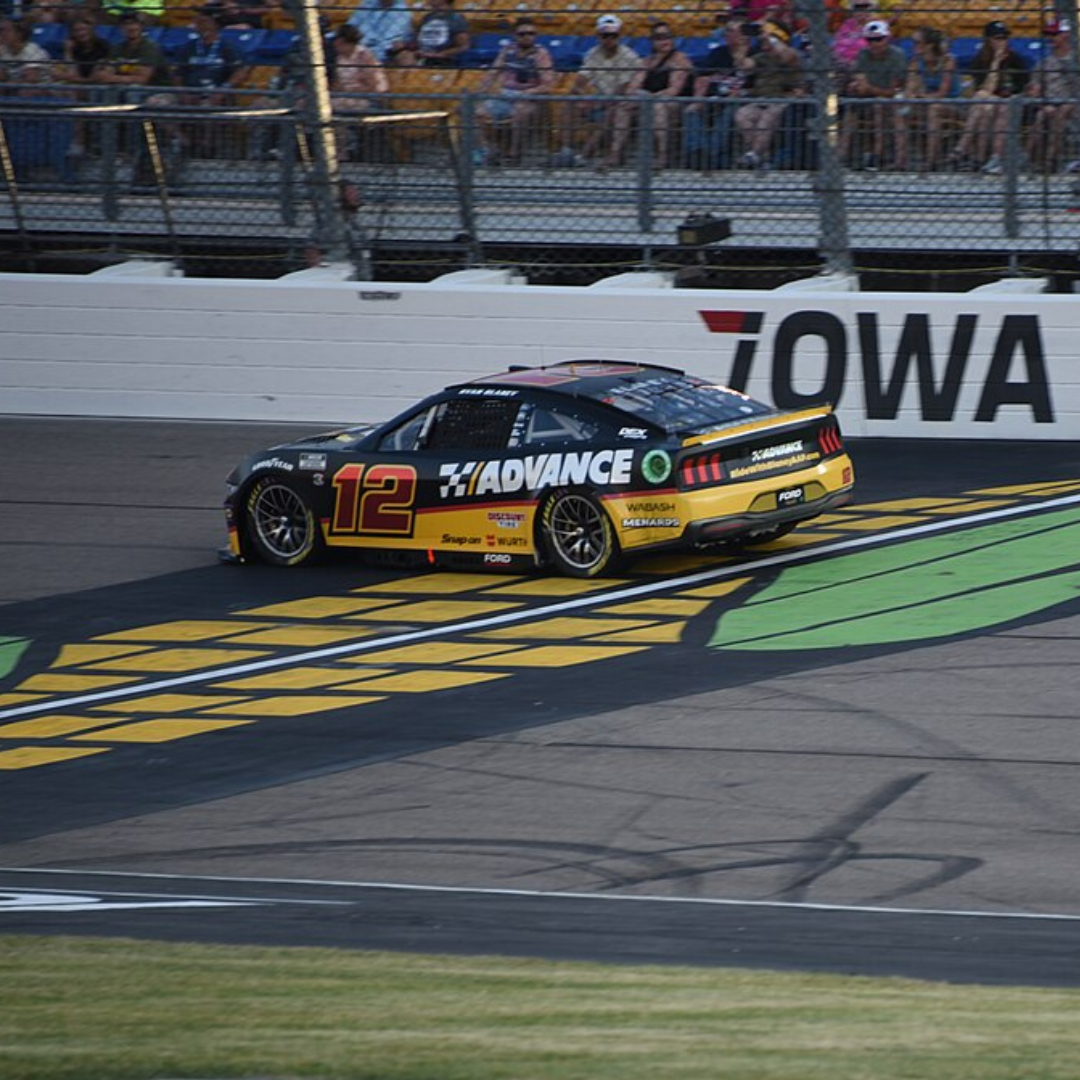
2023 NASCAR Cup Series champion Ryan Blaney en route to winning the inaugural Iowa Corn 350 at Iowa Speedway on June 16, 2024. Photo by Senior Master Sgt. Vincent De Groot via Wiki Commons.
On Jan. 12, NASCAR announced the new championship format for 2026 and beyond, as it moves past the elimination playoff format. While most of the industry can agree that the new format is a clear improvement, it still leaves clear legitimacy to be longed for.
NASCAR President Steve O’Donnell said during the 2026 format announcement,
“It just felt like the industry and everyone was really ready for us to make it as simple as possible, definitely reward winning, but have something to be able to be easily explained and that the industry could feel like this is where we want to be.”
In nearly every other motorsport in the world, the championship is determined by drivers earning points in each race of the season, and whoever scores the most points all year wins the title. However, that has not been the case for NASCAR since 2003.
In 2014, the playoffs were introduced, a format in which the top 16 drivers after the first 26 races would compete in a 10-race, elimination-style format. Anyone who won a race in the first 26 races would qualify, along with the top drivers in points, to reach 16 drivers. After three races, the last four drivers in points would be eliminated, and the points would reset entering the following round.
The final round would be four drivers in one race, where whoever finished the best among those four in that race would take the championship. This is where a major issue occurred; an entire season’s worth of work could mean nothing because you had a singular bad race at the worst time.
NASCAR finally realized its mistake in the 2025-26 offseason and changed the format once more to return to the Chase format from 2004-2013 for the 2026 season, but with some minor tweaks.
In the new format, the top 16 drivers in points after the first 26 races qualify for the playoffs, with those 16 being re-seeded for the final 10-race stretch. First place in the regular season starts with a 25-point advantage over second, with a 10-point gap from second to third, and a five-point gap throughout the rest of the grid. This means first place starts with a 100-point advantage over 16th place.
Of all of NASCAR’s postseason formats, this is by far the fairest, as the best drivers throughout the entire season still keep an advantage over the rest of the field. In addition, drivers who struggle throughout the first two-thirds of the season still have a chance at the championship, but must work exceptionally hard to dig themselves out of a hole.
However, this format still leaves true legitimacy to be desired, as any sort of points reset destroys all legitimacy. Someone could theoretically have a 1,076-point lead and the championship already locked up in a full-season format reduced to just 25 points and a likely chance at losing the title for the sake of entertainment.
NASCAR is not a stick-and-ball sport, and never will be. In those sports, teams play one-on-one and do not play everyone in the league throughout the season, making a playoff necessary.
In motorsports, however, everyone competes against one another numerous times throughout the season, leaving no question as to who the best competitor in the given season was. While the 2026 Chase format is absolutely a breath of fresh air for the sport’s legitimacy, more work still needs to be done.




Comments