
 Names introduced in quotation marks are pseudonyms used to protect students’ identities.
When DMACC student “Dylan Drake” had an assignment due at midnight in a couple of hours, he knew he wouldn’t have enough time to complete it since he had been procrastinating the whole week.
In truth, he barely even understood the assignment, let alone the purpose of the whole class. The assignment was for Intro to Literature, and Drake was only taking it because others said it was an easy class and a way to bump your GPA. Drake was sitting at a solid B, but he needed to bump his GPA a bit to keep above a 3.5 before transferring to Iowa, so he couldn’t just slack off; he had to hand in a paper that got him high marks.
So, he opened up ChatGPT, copied the assignment instructions, and pasted the output he got into a Word document, knowing this was his last option. He didn’t care about this class anyway and thought it would be useless in his future as his major had nothing to do with writing; he just needed that grade to look good. He turned the assignment in, knowing what he was doing was wrong and considered cheating, but to him, this was the only option.
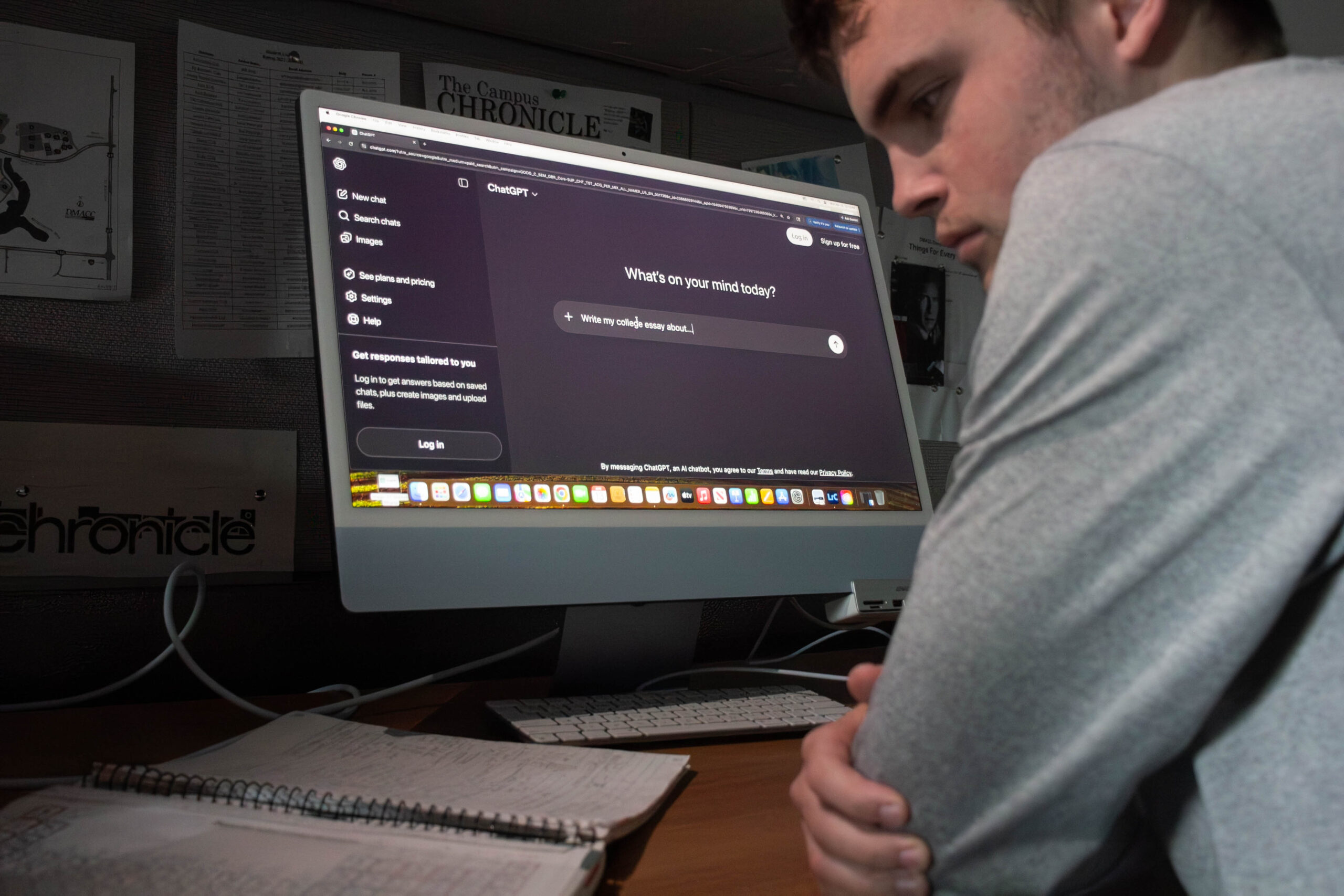
In a world where AI apps like ChatGPT and Google Gemini can do the “thinking” and writing for students, students’ experience and ability to learn are being negatively impacted.
It is so easy for students to pull up an AI tool and ask it to do their work for them, write an essay, or just give it a prompt to fulfill. However, this is not how it was intended to be used. As ChatGPT states, “AI tools like ChatGPT are designed to support human thinking not to replace creativity and decision making … It is not intended to replace human judgment, do academic work for students, or be used for cheating and bypassing learning but instead assist in making information easier to access and make learning faster while keeping humans in control of the final product and decision.”
Each DMACC instructor has developed guidelines for how generative AI may or may not be used in their courses. Here is an example of AI policies from a JOU165 (Principles of Advertising) DMACC syllabus: “AI is a tool that can enhance original work, but does not substitute for it. AI’s writing voice is distinct as is the writing voice of a student. Cite it if you choose to use it. If used improperly, it will be treated like plagiarism.”
While a HUM 120 (Introduction to Film) syllabus states, “The use of generative AI tools like Chat GPT are not permitted in this course and are considered a violation of DMACC’s Academic Misconduct policy.” It continues, “Students who are found responsible for a violation of the Academic Misconduct Policy will receive a zero for the assignment. A second offense will result in failure of the course.”
Dean of Academic Success Albert Farr has been at DMACC for eight years and has been teaching for a total of 18 years. Cheating, in his words, is defined as any work or production by a student that doesn’t reflect their input and was not produced or presented by the student. He said give credit where credit is due and always try to give credit.
Farr said cheating has been going on forever, and it is a mindset of, if students want to cheat, they will always find a way: “If there is a will, there is a way.”
“Most students don’t necessarily come in thinking ‘I’m going to cheat in this class’ because that’s not the purpose. I think people start classes with their integrity in mind and only fall prey to cheating when they’re not comfortable with the assignment or run out of time, as a last resort,” Farr said.
He views cheating as a last resort or desperation for most students and says some even do it unknowingly based on what they have learned and seen in high school.
“There is a team of people here to help you, especially at DMACC, and would love to see you succeed without going down that path to cheating,” Farr said. “Once you realize that, there’s nothing you can’t accomplish. Nobody wants you to come to class and not do the work or master the subject. We want to see you smiling while crossing that stage at graduation.”
“Blake Bennett,” a first-year student majoring in English, said, “I have never cheated, and sometimes it can be hard to cheat in certain classes and majors. Other times, you may have other time commitments or things you have to worry about, like work or family problems.”
“Nico Norris,” a second-year student majoring in Business, said, “It’s better to cheat than repeat.”
“Ella Emerson,” a first-year student said, “The class was too boring and was not important, and I didn’t need it to graduate, so it was basically a GPA booster.”
“Luna Lawson,” another second-year student majoring in Liberal Arts and Sciences, said, “Why learn the concepts and ideas when you can cheat? Why would I ever need this stuff in my life and future and when would I ever use it? I only need the bare bones and minimum.”
“Jazzy James,” a second-year student majoring in Fashion, said, “Cheating is bad if you are paying for a class, you are wasting your time and not actually learning anything. You don’t know if that topic or thing that you are learning might open another door or be useful in the future.”
Aimee Langager, professor of speech and English at DMACC, says the most common type of cheating is AI. Along with this, she sees Wikipedia and Quizlet occasionally, too, although these are easier to spot. She tries to be generous and lenient with students.
“With AI, you don’t get an easy detection, because it is generating thoughts for you. So you really have to have a conversation with students about their thought process and what they were thinking,” Langager said.
Langager said she wants the work to come from the student’s brain and be their own genuine thoughts. She said she loves learning, and sometimes students can feel like they are just checking boxes, but she makes her classes so that it is less about points and grades and more about learning, developing skills, and thinking critically.
She says cheating could perhaps be avoided with better time management. She said she knows many students are balancing a lot in their lives, so they turn to cheating as a shortcut.
She added that AI is like a “plagiarism machine” if used incorrectly.
“Use the resources if you are feeling overwhelmed, or if you don’t understand something, ask,” Langager said. “Say you are overwhelmed and ask for help, and most professors will have you prioritize something and ask you just do your best,” Langager said.
Associate Professor of English Colin Hogan has been at DMACC for four years. He defines cheating as when students offload intellectual work that the course is asking of them and try to dodge or work around. He points out that every instructor will have a different policy and different views on what academic misconduct may be viewed as.
“In a perfect and ideal world, there would be lots of really great applications of AI. Unfortunately, we don’t, and we have a lot of malevolent actors who don’t have the best interest of everyone in mind,” Hogan said.
Hogan said there are four basic reasons why students tend to use AI. Students can be too busy, they don’t understand the material, don’t value the material, or the professors are not doing a good enough job. It is hard to see the payoff in the long run, and students don’t see the relevance for the rest of their lives.
Hogan encourages students to ask questions and build a relationship with their professors to know they are someone you can lean on when you are struggling, and they can always help you out.
Hogan said AI can be a part of the process, but going forward, stick to what you know and don’t just copy and paste everything you get back. Try to learn from it and learn the process and concepts of the class. If you just copy and paste and cheat your way to a grade, what did you really learn on the way? You are cheating yourself out of knowledge, valuable lessons, and information.
“If all you can do is ask AI, so can we all,” Hogan said. “There is no way to distinguish yourself from anybody else.




Comments